What is your theory of learning as an educator? That is a question that I have asked my-self several times over. Learning can be demonstrated in many different ways. Some of the different theories of learning that I have taken a look at are Behaviorist, Cognitivist, and Constructivist. These are all theories of the 20th century.
20th Century Learning Theories
1. Behaviorism
Behaviorist learning focuses on learning that can be observed and measurable. Ivan Pavlov was one of the first to take a Behaviorist approach. His learning theory became known as Classical Conditioning. Another contributor to the Behaviorist theory was B.F. Skinner. B.F. Skinner was different from classical conditioning. His type of conditioning was Operant Conditioning. One of the best examples of B.F. Skinner is this quote.
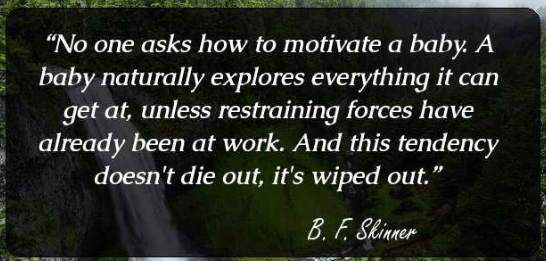
I couldn’t agree more with this as a teacher. Children are born with an ability to learn for the sake of learning. Why does this disappear? B.F. Skinner would look at the student’s behavior and observe over the years. He would claim that Students are conditioned to stop wanting to learn in the ways that they are born. Teaching is training for new behavior
2. Cognitivist
Learning here is the process of information. This theory originated from the creation of the computer. Like a computer Cognitivist look at how humans process and make meaning of information. Information is processed into meaningful wholes that are connected to prior learning. Through this form students are asked to make connection to past learning. In this theory the students is only asked to learn what the teacher presents. Teaching is a transmission of information to learners.
In looking at my past I would say that I first started out as a teacher in the cognitivist approach. I spent a large amount of time creating lessons that were primarily teacher centered. As I started to develop my own teaching style I started to move farther away from this approach.
3. Constructivist
Constructivist developed out of behaviorists and Cognitivists ideas. In this theory learning is making meaning of doing.
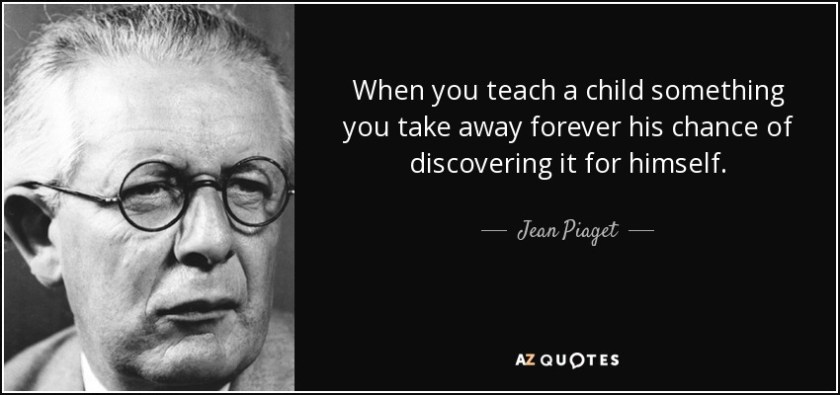
Jean Piaget’s quote is the embodiment of what he thought learning should be. Students should be learning through exploration and self discovery. Teachers facilitate activities for students to make meaning. In this theory students fit into the idea of B.F. Skinner and the growth mindset. Students explore and create their own meanings.
21st Century Learning Theories
1. Collaborativist
In this theory students focus on the knowledge building process. Collaborativism provides a learning theory and pedagogy that addresses 21st-century needs and opportunities. In an online world students work to build on the vast amounts of information that is provided further than the textbook. Groups of students work together in order to develop their own set of understanding and learning.
2. Connectivist
In 2004 Stephen Downes and George Siemens pronounced this new age approach to learning. They argued that learning is a process of connecting with modes of information and that learning resides not only in the human learner but also in non-human appliances.
“it would flex and bend and reshape itself minute by minute according to where you are, who you’re with, what you’re doing, and would always have certain resources top of mind could be displayed in any environment or work area” Stephen Downes (Harasim, 2017)
So what is my philosophy of learning?
Early on in my career I would say that I was a Cognitivist. I spent days on end lecturing and expecting students to transfer that information back to me. That is what I thought good social studies teachers did. Over the past several years I have spent more of my time trying to develop more along the lines of Collaborativist and Connectivist. This is also why I am trying to incorporate Blended Learning into my school district. When I looked at the 21st century learning theories it couldn’t have fit any better with blended learning.
So what is my learning philosophy? Just like blended learning I would like to think that it is a combination of several learning philosophies. I know that I was once a Cognitivist and that I am trying to move closer to collaborativist and connectivist. So what does this look like. It looks like creating an environment of learning where students work together collaboratively. They look over a variety of materials trying to make connection to real life experiences. I believe that these connections are the true future of education. These ideas are built on the ideas of Piaget with constructivism. By building a blended learning environment learning is turned back to the students. Students are given the freedom to develop their own sense of learning.
That sense of learning goes along with my Significant Learning Environment. As an educator I need to create the right environment for my students to be able to incorporate collaboration and making connections to learning. In order to do that I need to understand my own learning. I look back at some of my most meaningful learning experiences. I think the key word is experiences. I spent many of days working in the garage with my father. The relationship that was create in those hours of working in the garage helped develop my learning. I think that is the next piece to my learning philosophy. As an educator I need to continue to develop relationships with my students. By building these relationships I can create the learning experiences that can be meaningful. By understanding my learning theory, I can reflect on my practice, improve upon, reshape and refine my work, and contribute to advancing my classroom.
Resources
Blake, B., & Pope, T. (n.d.). Developmental Psychology: Incorporating Piaget’s and Vygotsky’s Theories in Classrooms . Journal of Cross-Disciplinary Perspectives in Education , 1(1), 59–67. Retrieved from https://tobh.pw/1560942072.pdf
This article discusses Jean Piaget and Lev Vygotsky theories of student learning and how they can be incorporated into the classroom.
Harasim, L. M. (2017). Learning theory and online technology: how new technologies are transforming learning opportunities. New York: Routledge.
In this book Harasim, looks at past theories from the 20th century Behaviorist, Cognitivist, and Constructivist. It also looks into new learning theories like Collaborativist and Connectivist.
 leigh4education.school.blog