Over the course of five weeks this course has helped me understand the vastness of becoming a better digital citizen. Prior to this course I felt as though digital citizenship was just another hoop that teachers needed to jump through. Like many teachers I felt the curriculum was the most important part of my classroom. I can briefly touch on digital citizenship and yes, I teach it here and there. Many may think that digital citizenship is something that should be taught in computer class and not in social studies. Soon after starting this class I began to change how I thought about digital citizenship.
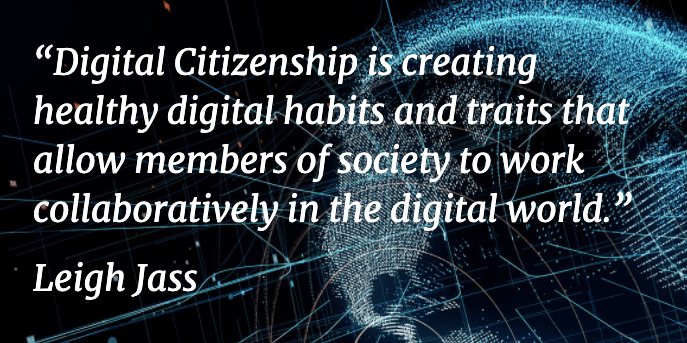
In the first week I was tasked with understanding truly what digital citizenship was. This was more difficult that what I thought it would be. It was difficult for me because I looked at in two different forms the educational classroom and the digital world. I wanted my definition to be unique but yet combined both areas. So, after working through a number of different ideas I felt that I had finally come up with something that did just that.
This course was challenging at all corners of this class. The case stories that were presented in this class were very complex. The case studies forced me to think deeper and use critical thinking. The case studies helped me understand the vastness surrounding copyright laws and cyberbullying. I have never had to work that closely with either of these topics. So, because of my lack of experience in these areas, I think this led to my overall challenges.
In this course the overall amount of information and videos was extremely vast. This course had a lot of information for five weeks. I struggled to wrap my mind around the true nature of the content shared. As I started to look at what my culminating project would be, I started to gravitate towards creating an effective digital footprint. In order to create an effective digital footprint student, need to develop skills in and around Mike Ribble’s nine elements of digital citizenship.
As instructional coach in my building I look forward to sharing my knowledge of the nine elements. I can see that these nine elements can be broken down and used in our advisory groups. I would like to create lessons related to each of the nine elements. These lessons can be used in turn to help students create digital citizenship. Digital citizenship is something that I think my school district is lacking. My school district just recently went to 1:1. With these students have been given a major tool but little educational guidance. As students start to develop these skills, they will then be able to develop a proper digital footprint. Creating a digital footprint can be very beneficial to their future. Not only can it help them get into college but it can also help them later with getting a job. Colleges and employers are looking at future candidate’s digital footprints. I want to make sure that my student’s digital footprints are of those that will benefit them and not hurt them.
Resources
Ribble, M. (2010, February). Raisinga digital Child.
Retrieved from https://nebula.wsimg.com/075a281e88861c989f4f72df356a7966?AccessKeyId=89A3305 FD4C7828E994F&disposition=0&alloworigin=1
Ribble, M. (2008). Passport to digital citizenship journey toward appropriate technology use at school and home. International Society for Technology in Education, 14-17. Retrieved from https://nebula.wsimg.com/aa295f4780423086c60c0ef40076b82f?AccessKeyId=89A3305 FD4C7828E994F&disposition=0&alloworigin=1
Ribble, M., & Park, M. (2020, September 09). Making Digital Citizenship “Stick”. Retrieved from https://www.techlearning.com/resources/digital-citizenship-framework-updated
 leigh4education.school.blog